 Customer supportExample
Resolved support conversations, software
Customer questions, agent replies and the confirmed fix, one ticket at a time.
- Industry
- Software
- History
- 3+ years
- Size
- 10K–100K tickets
Open for offers2 offers
How it works
First you find out what your records could earn. If you want offers, you list your card and approved buyers bid. Here is each step, what happens after you accept an offer, and why it costs you nothing.
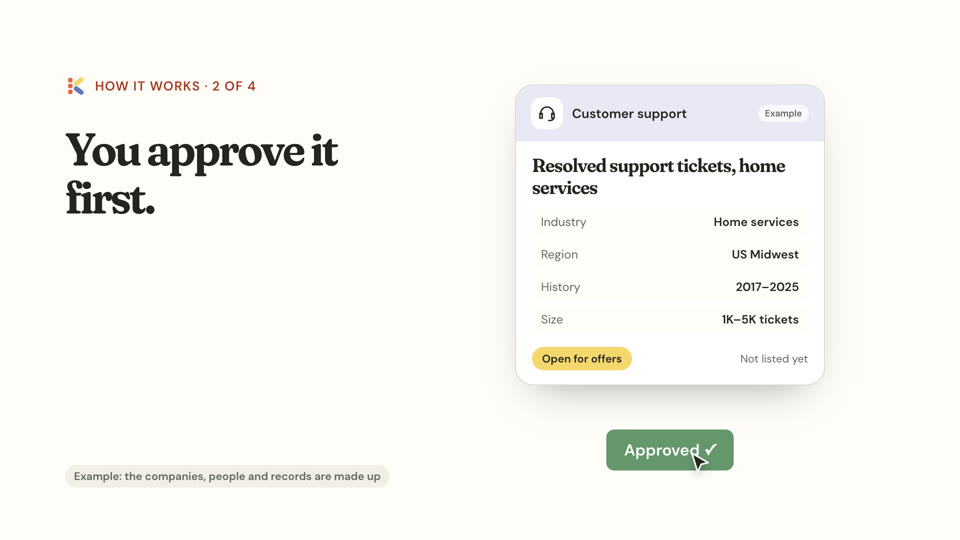
What’s my data worth?Tell Korra about your business on the home page. In a few minutes you get a starting range and a data card. No files, no logins.
If you want offers, read your card and list it yourself, or book a 15-minute call and Korra lists it with you. Your card is de-identified before anyone sees it.
Every card says Checked by Korra when it lists. After a short call with Korra, it says Verified by Korra. Buyers see which.
Buyers read your card, ask questions, and send sealed offers. You see every offer.
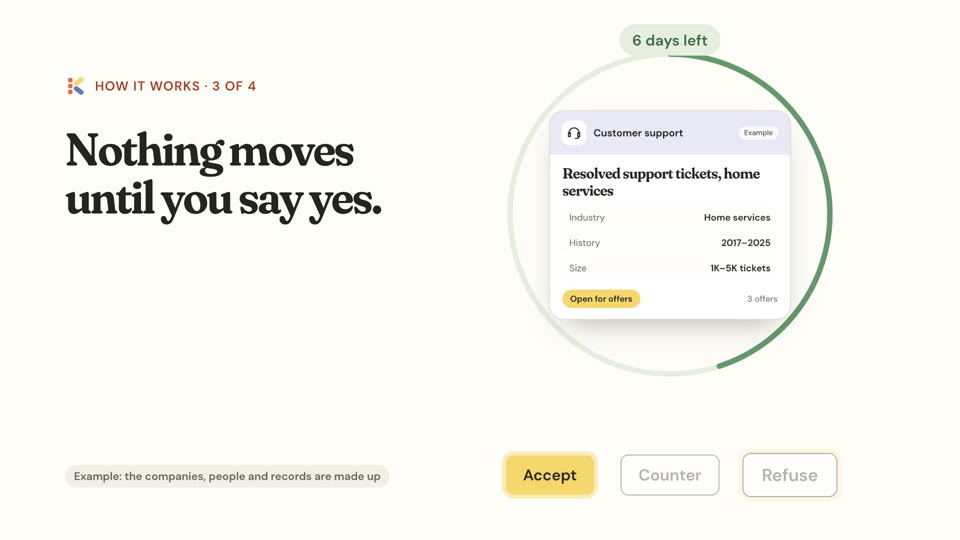
Accept, counter, or refuse. When you accept, you and the buyer talk in the portal and use our template paper if you want it.
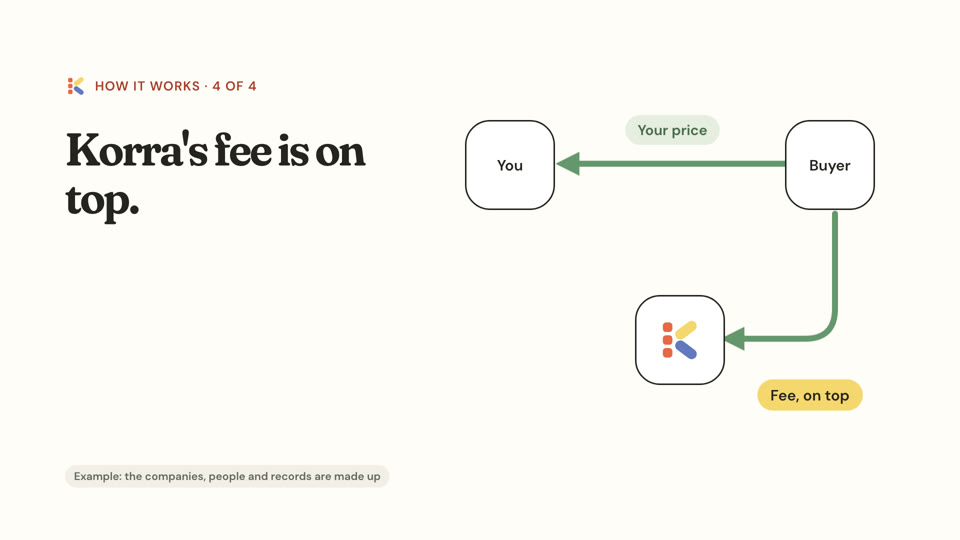
Price and date go in writing between you. The buyer pays you and pays Korra's fee on top. You pay nothing.
You do not sell your business or your systems. You license a copy of past records for uses you agree. A licence gives a buyer permission to use that copy. It does not by itself transfer ownership.
Nobody gets into your systems. The buyer gets only the copy you agree to send, in the way you agree to send it.
Eight kinds of records, each with a plain example. You do not upload anything. You tell Korra what you have, and your range and your card come from that.

The discussion behind a decision.
See an example
Requests, replies, and the work between.
See an example
From first inquiry to a recorded outcome.
See an exampleA problem, a response, a resolution.
See an example
The knowledge that makes a task possible.
See an example
Spoken work, with the right permissions.
See an exampleThe steps, rules, and exceptions of a task.
See an example
An output, a correction, and the reason.
See an exampleWhen you list, your card shows on the shelf. It tells a buyer what the records are, without saying who you are. It says Checked by Korra when it lists, and Verified by Korra once we have spoken with you.
The card is de-identified before anyone sees it: your company, people, addresses and one-of-a-kind figures come out. Removing names does not make records anonymous, so you still decide what you share with a buyer later.
Customer supportExampleCustomer questions, agent replies and the confirmed fix, one ticket at a time.
Sales recordsExampleQuote requests, the back-and-forth, and the recorded reason a deal was won or lost.
Operational workflowsExampleEach order, who approved it, what went wrong, and how it was put right.
Business emailExampleRequests from business clients and the replies that resolved them. Client files left out.
Made-up examples. Not real listings, sellers or bids. A real card is made from your own answers, and you approve it before anyone sees it.
Approved buyers read your listing, ask questions through Korra, and send sealed offers. An offer stays open for a 14-day window.
You see every offer. Each buyer sees only its own. You accept, counter, or refuse. Nothing moves until you accept.
Your portal shows every offer, every question, and how long the window has left. You decide each one.
When you accept an offer, the card shows “In talks”. You and the buyer learn each other’s names and talk in the portal.
You have 14 days to sign between you. If you do not sign, the card reopens for offers.
Use it, change it, or bring your own. Korra is not a party to your licence.
The price and the payment date go in writing between you and the buyer. Payment can come as fast as 7 days; usual terms are net 30. The typical range on the shelf is between $200K and $2M. Your offers set your number.
Nothing. The buyer pays you the price you agree and pays Korra’s fee on top. The fee does not come out of your price.
Korra lists your card, connects you with buyers, and hands you the paper.
A starting range and a data card in a few minutes. Nothing to upload, and it costs you nothing.
Ask Korra on the home page. Describe your business and where your records live. In a few minutes you get a starting range and a data card. It is a starting point, not an offer, and it costs you nothing.
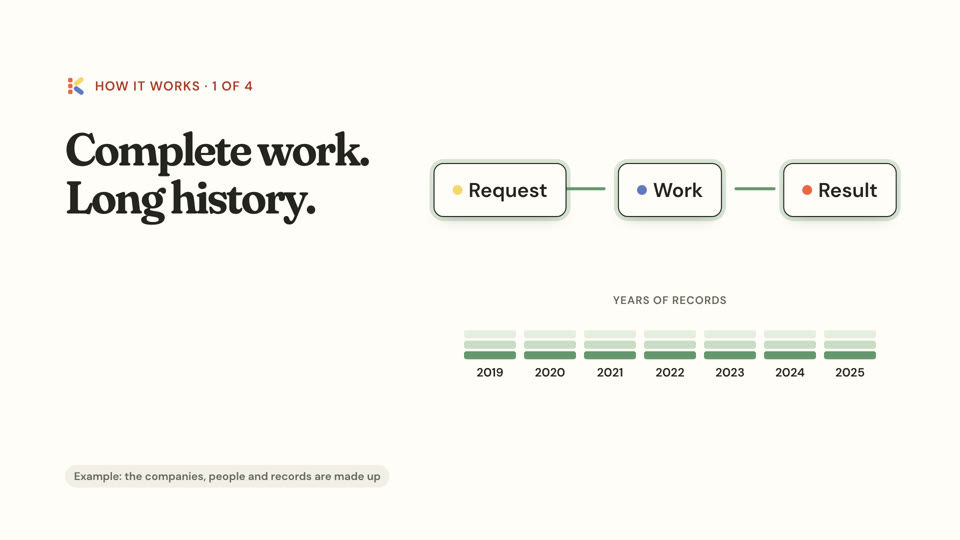
Records your business owns that show real work: emails, team chats, sales records, support tickets, documents, call transcripts, task histories, and saved AI reviews. Good records show a request, the work, and the result.
No. You describe your records: the record type, the years, a rough count, and what to leave out. Your files stay in your systems.
A few minutes in the chat for your range and your card. If you want offers, you read your de-identified card and approve it, and Korra reads it before it lists.
Yes. Book a 15-minute call. Korra goes through your card with you and lists it, and buyers see it as Verified by Korra.
Every listed card says Checked by Korra, which means Korra read the card before it listed. After a short call, it says Verified by Korra, which means Korra has spoken with you.
Anyone can see your de-identified card on the shelf. Only approved buyers can read the full listing, ask questions, and make offers. Your company, names, and emails come out of the card. A buyer learns who you are only when you accept its offer.
An offer only you and that buyer can see. Other buyers do not see it. Once three buyers have bid, the highest bid shows on your card.
Yes. You decide every offer. You can accept, counter, or refuse, and nothing moves until you accept.
The typical range is between $200K and $2M. Ask Korra for a starting point for your business. The offers you receive set your number. No sale is guaranteed.
The buyer pays it, on top of the price you agree. You pay Korra nothing, and the fee does not come out of your price.
You and the buyer set the price and the date in writing. Payment can come as fast as 7 days; usual terms are net 30.
No. Korra lists your card and connects you with buyers. You and the buyer agree how records move between you. Korra offers a delivery checklist you can use.
No. You license a copy of past records and keep ownership. Buyers never get live access to your systems, and you choose whether a licence is exclusive.
Your card is de-identified: your company, people, addresses, and one-of-a-kind figures come out before anyone sees it. Removing names does not make records anonymous, so you decide what you share with a buyer and how.
No. Korra runs the shelf. The buyer is the company whose offer you accept, and the licence is between you and that buyer.
Yes. Complete examples of real work matter as much as volume. Ask Korra what your data is worth to start.
Say so in the chat or when you list. Check customer terms, employee information, and material owned by others with your own adviser before you sign a licence.
Usually not. Only records your business owns and can share. Agencies, accountants, and law firms often hold client files they may not license.